

I Built a Dam. One day, the River Took It Back
My phone rang, jolting me awake. Before I even answered, I knew something had gone terribly wrong.
My phone rang, jolting me awake. Before I even answered, I knew something had gone terribly wrong. Groggy from an afternoon nap, I picked up the call. On the line was my farm hand, panicked and almost incoherent.
“Calm down, what are you saying?” I asked
“The dam is overflowing and almost bursting, please come quickly!” He replied out of breath.
It was now my turn to panic. In a daze, I slid on some shoes, picked up my car keys, and dashed out of the door. It was raining, but I did not care. My only concern was the dam. How bad was the damage? Would the rain stop? These were the questions ringing in my mind. I put the pedal to the floor and drove like a maniac.
The rain was relentless. The wipers worked furiously, but they couldn't clear the windshield fast enough. Every few seconds another sheet of water blurred my view, forcing me to ease off the accelerator before pressing down again. Small streams had already formed across sections of the road, and I could feel the car tug slightly whenever I drove through them.
I realized halfway there that my shoulders were aching. I had been gripping the steering wheel so tightly without even noticing. I kept telling myself to slow down, but another part of me was screaming that every second I wasted was another second the dam was fighting a battle without me.
The phone vibrated again on the passenger seat. I glanced at it but couldn't bring myself to answer. What if the next call was to tell me the dam was already gone? My mind kept bouncing between hope and despair.
Maybe the overflow wasn't as bad as they thought. Maybe we could still save it. Or maybe I was already too late and was driving toward two million shillings being washed downstream. The uncertainty was worse than the rain.
The phone rang again. I hesitated before answering it. I was not sure I could stomach it if it were more bad news. I steeled myself then picked up the call.
“Boss, boss. Where are you?”
“I'm on the way,” I answered and hung up.
If the situation had worsened, I would rather see it firsthand. Calls have a way of giving me anxiety, and I was already past my threshold.
My dam was massive. By the standards of a small-time farmer anyway. It had a capacity of six million liters and cost me nearly two million Shillings to construct. At one hundred and twenty feet on both length and width sides, and twelve feet deep, it was enough to serve me for almost nine months.
Building the dam wasn't just another project. It was the foundation on which I intended to build the entire farm. Water is everything in agriculture, and this dam was supposed to free me from depending on the unpredictable rains.
I still remember the day construction was completed. I stood on the embankment long after everyone else had left, looking down at the water and imagining what the farm would become. In my mind, the difficult part was behind me. The dam was there. The rest would be a matter of hard work. Looking back, I smile at how certain I was.
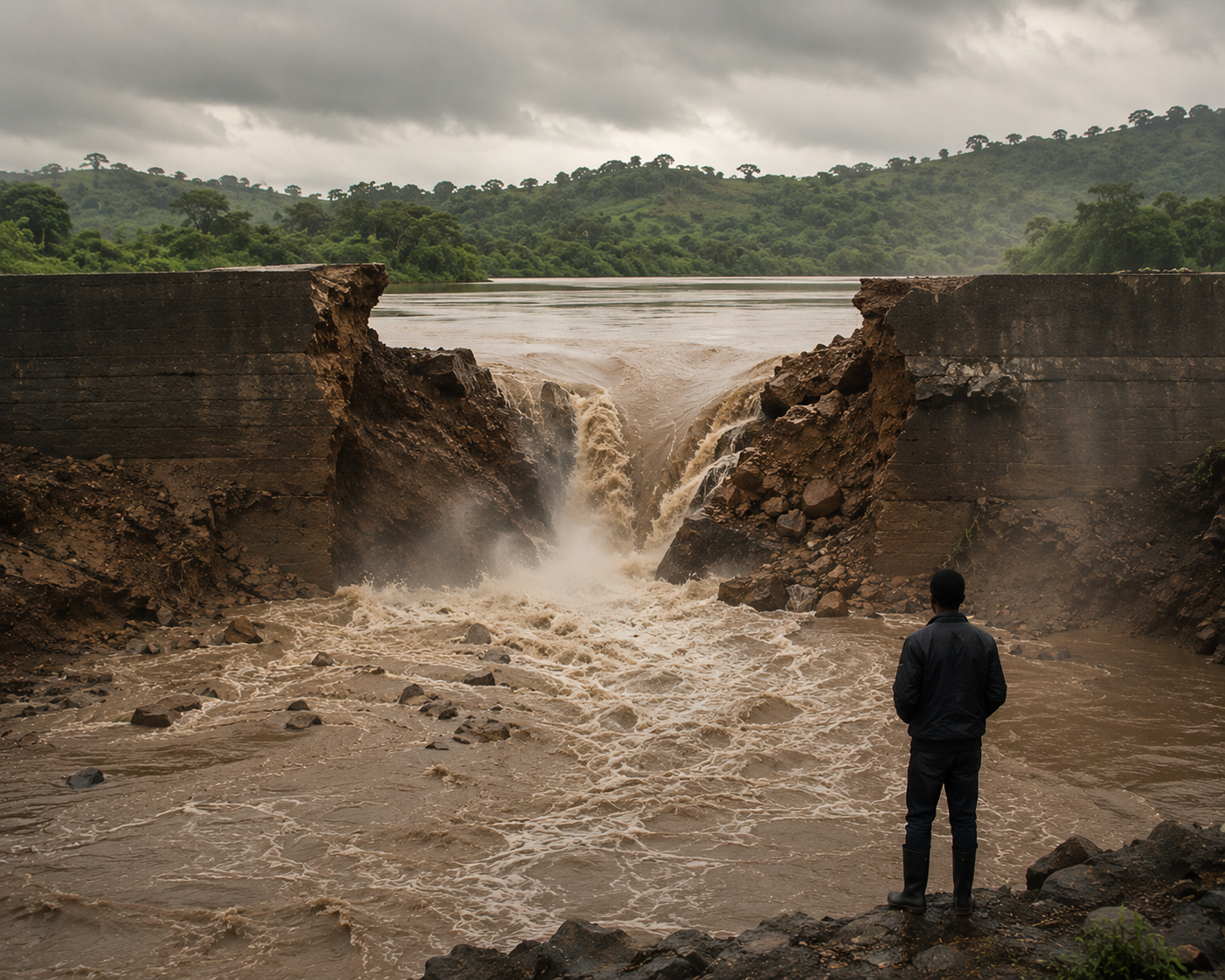
The noise was deafening. I'd never heard water sound so angry before. It crashed against the banks with a force that made conversation almost impossible, and every few seconds another branch or uprooted shrub came hurtling downstream.
The smell of soaked earth hung heavily in the air, the kind that normally signals life after rain. That day, it smelled like destruction. My clothes were drenched within minutes, but I barely noticed. My eyes never left the dam.
We tried getting closer, but the mud had other ideas. Every step sank deeper, and my gumboots felt as though they were being pulled off my feet. The farm hands shouted to each other over the roar of the river, though I couldn't make out half of what they were saying. It didn't really matter.
There was nothing any of us could do. We stood there, watching years of planning and millions of shillings being humbled by a force that neither concrete nor confidence could hold back.
The dam itself was full and had burst on one side. I began to count the loss subconsciously.
I was now calm. Panic had given way to acceptance. As I saw the ongoing destruction, I tried to figure out what could have gone wrong. Despite it being an El Niño season, clearly the ‘expert’ who had chosen the location had made a bad miscalculation.
I remember the day we were choosing the location. The engineer walked around with his tape measure and notebook, stopping every few meters to take readings. We followed him quietly, trusting that he knew what he was doing.
Off to one side stood an elderly Maasai man, watching us with mild amusement. This land had been his home for decades. He had seen more rainy seasons than all of us put together. After a while, he walked over, pointed toward the river, and shook his head.
"Don't build it there," he said. "When the long rains come, the river becomes wild”
He suggested moving the dam farther away from the river's path.
We thanked him politely but followed the engineer's recommendation. After all, one man had formal training while the other knew the land because he had lived on it his entire life.
Standing there now, ankle-deep in mud as the flood swallowed the farm, I couldn't stop thinking about that conversation. The engineer had given us calculations. The old Maasai had given us memory. It turned out the river respected memory far more than mathematics.
As expected, the contractor refused to take responsibility for the design flaw. He attributed it to an act of God, and there was nothing I could do about it. The loss was mine to bear.
The drive home was eerily quiet. The rain had eased, but I barely noticed. I drove slowly this time, exhausted more than anything else. When I got home, I left my muddy gumboots by the door and sat staring at them for a while. They were caked in the same mud that had swallowed the farm. I wasn't ready to talk about what had happened. I wasn't even sure I had fully accepted it myself.
Sleep didn't come easily that night. Every time I closed my eyes, I saw water pouring over the dam and heard the roar of the river all over again. I found myself checking the weather forecast every few hours, hoping the rain would stop even though there was little left for it to destroy.
Somewhere in those long hours, a thought crept into my mind that I couldn't shake: maybe I was cursed. Too many promising projects had ended the same way, and for the first time, I wondered if the problem wasn't the businesses I chose, but me.
I think I'm built differently. I didn't cry; I didn't moan about it, but immediately set out to try to conjure ways of rebuilding the dam and how to get finances. I am an ardent believer in failing fast. Fail, move on, quickly. It was not as easy as it may sound, but somehow I managed to. On the drive back, I was already planning the next step.
The amount of damage was enormous. The dam liner was destroyed; one whole bank was washed away, but the biggest issue was the silt deposited by the flood. Remember I told you the dam was twelve feet deep? About three-quarters of the dam was now filled with sand.
After surveying the scope of work required for repairs, I was unable to visit the farm for three months. I did not have the strength. Seeing the damage just weakened my soul more. I needed space to breathe and recalibrate.
For a long time afterward, rain stopped feeling like a blessing. Whenever dark clouds gathered, I found myself instinctively reaching for my phone, half expecting it to ring.
The first drops on the roof no longer made me think of greener pastures or full dams. Instead, they made my pulse quicken. I would catch myself wondering whether the river was rising again, whether another project was being washed away while I sat helplessly miles from the farm.
It took me a while to realize that the flood had left me with more than a damaged dam. It had changed my relationship with rain itself. I used to enjoy listening to it at night. Now I lay awake whenever it poured, checking weather forecasts far more often than I should have and hoping morning would come with clear skies. It's strange how one bad day can steal the innocence from something you've loved your entire life.
A few months down the line, we began repairs. It was not easy. We had to remove the silt, level the banks, fortify the outer walls with concrete, and install barriers to prevent a repeat of the flooding. Basically, it was re-engineering the whole project.
The silt was the main challenge. Because sand is tricky, we couldn't use heavy machinery to excavate it. We tried using a bulldozer, and it got stuck. We had to resort to good old manual labor. It took twenty people one whole month to remove all the silt, which was laborious, time-consuming, and expensive, but we had no option.
Having identified the structural weaknesses in our initial design, we shored up the structure, giving it greater resilience and vitality. That took a lot of money. Because we couldn't move the dam, we had to protect it from future floods. It entailed having a double barrier of six-foot concrete walls, which would reduce the force of water in case it rained heavily again. Hard work, but we rebuilt the dam.
These days, when the rain starts falling, I no longer hear only the promise of a good harvest. I hear a quiet reminder to respect forces bigger than myself, to plan with more humility than confidence, and to remember that sometimes the river already knows where it intends to go. And sometimes, I wonder how many of life's biggest losses begin with ignoring the quietest voice in the room.

0 responses